User list#
A list of every account — site visitors as well as the people who work in the administration. It is one list; what someone may do is decided by their role, not by where they appear.
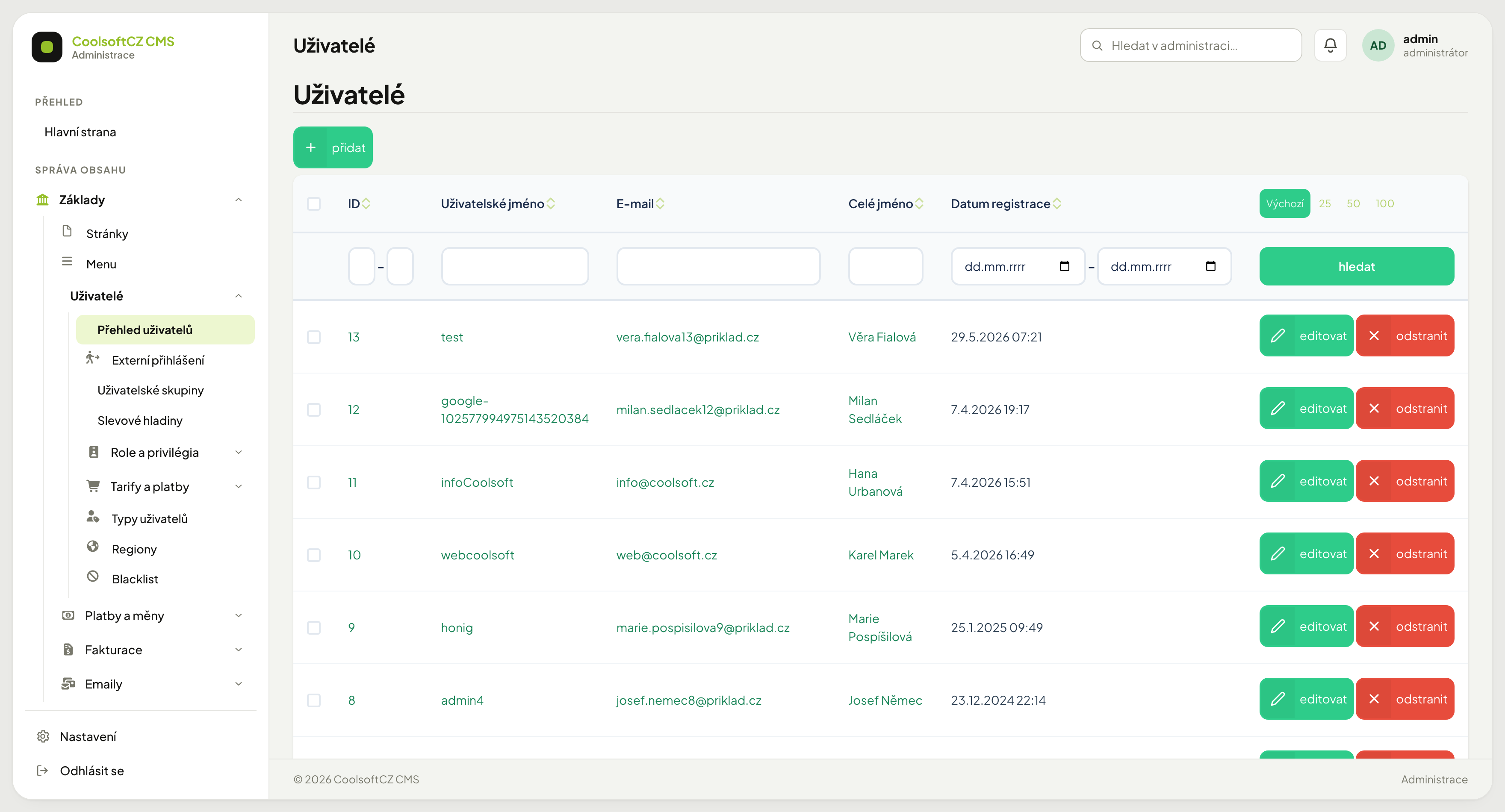
Find it under Základy → Uživatelé → Přehled uživatelů.
The list#
| Column | What it shows |
|---|---|
| ID | the account number |
| Uživatelské jméno | what the person signs in with |
| address for notifications and password recovery | |
| Celé jméno | first and last name |
| Datum registrace | when the account was created |
The username is not the email
They are two separate values. The system authenticates by username; the email is for communication. They may differ, and often do — accounts created via Google or Facebook have a machine-generated username.
Creating an account#
- přidat above the list.
- Fill in the username, email and password.
- Add the first and last name.
- Assign a role — without one the person can sign in but sees nothing.
- Save.
You usually do not create visitor accounts by hand — they come from registration on the site. Manual creation is for colleagues who need the administration.
Editing an account#
The form is split into sections: sign-in details, personal and address details, company details. See Working with forms.
Leaving the password blank erases nothing
The Heslo and Heslo znovu fields are always empty when opened. That does not mean no password is set — it simply is not displayed. Leave them blank and save and the existing password stays.
Company details#
Ticking Firma enables company name, registration number and VAT ID.
Unticking Firma does not clear the existing details by itself
The fields just get hidden — whatever is still typed in them gets saved on submit. To actually clear a account's company details, delete their content by hand.
Resetting a colleague's password#
The administration has no public password recovery. When someone cannot get in:
- Find their account.
- editovat.
- Fill in both Heslo and Heslo znovu.
- Save, and pass the new password on by a route other than the email address they cannot reach.
Blocking an account#
The form has two toggles at the top right:
| Toggle | Meaning |
|---|---|
| Aktivní | a disabled account cannot sign in |
| Zabanován | the account cannot sign in and its public profile shows a red "Banned" badge |
Either one closes access — switch Aktivní off, or switch Zabanován on. This holds for both sign-in routes: by password and through a third-party account (Google, Facebook and the others under Login providers).
Which toggle when
Aktivní is an operational state — the account is awaiting email confirmation or someone parked it for a while. Zabanován is a penalty for behaviour, and others additionally see it as a badge on the public profile. For closing access the two are equivalent.
Open sessions end, though not to the second
Saving revokes every signed-in session of that account, on every device where they were signed in. Anyone with a window open at that moment keeps it for at most another 15 minutes; after that the session is not renewed and the system drops them. They cannot sign back in.
Blocking beats deleting
Deleting an account cannot be undone and takes its links to orders, adverts and posts with it. When someone should merely lose access, switch Aktivní off or ban them.
Searching#
You can filter by ID, username, email, full name and a registration date range. Filters add up — see Search and filters.
Deleting#
Deletion is irreversible and has consequences
An account is tied to orders, invoices, adverts, comments and ratings. Deleting it breaks those ties. Before deleting, check that nothing is left behind — otherwise switch Aktivní off instead.