Variants and parameters#
A parameter is a property of the goods — size, colour, power output. It serves two purposes at once: customers filter by them, and some of them decide which variant is being bought.
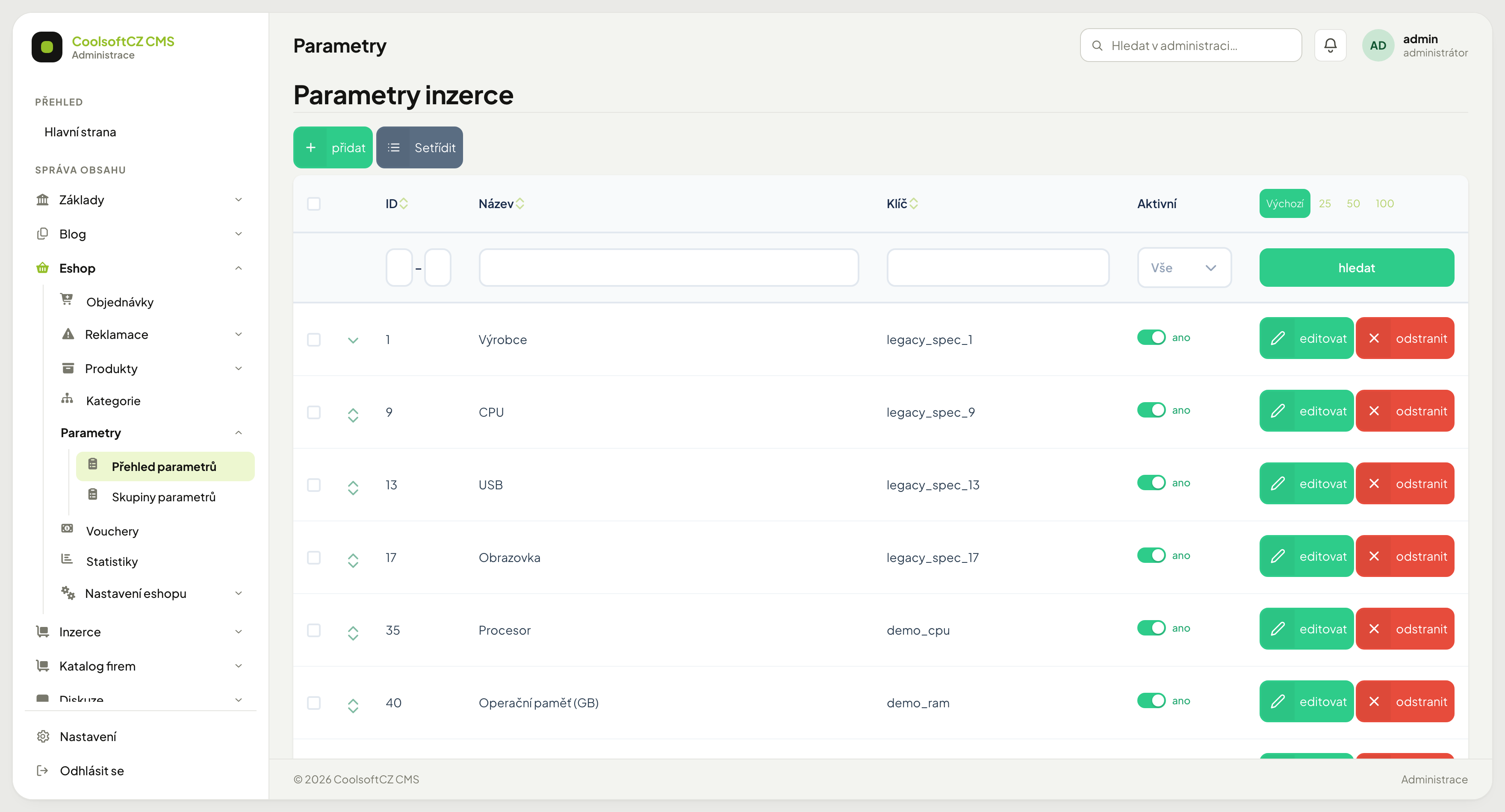
Find them under Eshop → Parametry.
A parameter with options, or with a value#
| Type | Example | When |
|---|---|---|
| With options | Colour: blue / red / black | there is a finite set of repeating values |
| With a value | Weight: 3.2 kg | each item has its own number or text |
Sensible filtering works only with options
Options give the customer a list of checkboxes. Free text does not — the filter either is not offered or is unusable. Whatever belongs in the filter should use options.
Parameter groups#
Parameters are bundled into groups (Dimensions, Technical data) which decide how they are ordered on the product page and in the filter. Without groups the filter is one long unreadable column.
Parameter settings#
| Setting | What it does |
|---|---|
| Required | the goods cannot be saved without it |
| Always visible | shown even when empty |
| Number of options shown | how many options the filter shows before expanding |
| Match all values | see below |
Number of options shown#
A parameter with twelve options turns the filter into an unreadable wall. This number says how many appear straight away; the rest hide behind "Show all".
Six tends to be a good compromise
A ticked option is always displayed even if it would be among the hidden ones, so the customer never loses sight of what they selected.
Match all values#
Decides how the filter behaves when a customer ticks several options:
- off — any of them will do (blue or red). This is what most shops want.
- on — all must hold at once (blue and red).
Never turn it on for a single-value parameter
Goods have one colour. Nothing satisfies "blue and red at the same time" and the filter will always come back empty. It only makes sense where goods can hold several values at once — Properties: waterproof, breathable, for instance.
Variants#
A variant is another product set under the same product, with its own parameter values. From "T-shirt" comes the set "T-shirt, M, blue" — with its own code, price and stock.
Adding a variant#
- Open the product.
- Go to the product sets.
- přidat and fill in the parameter values that define the variant — size and colour, for instance.
- Fill in the code, weight and other set fields.
- Save, then set the price and stock.
Every variant needs its own price and stock
A newly created set has no price and zero stock — and such goods cannot be bought. After adding a variant, always go through both.
Translating options#
Parameter options are translated like any other content. An untranslated option appears in the foreign-language version with no name — an empty checkbox in the filter.
An empty translation is worse than a missing one
Empty text prevents the fallback language from stepping in, so the option stays nameless. After adding a language, go through the parameters and fill the options in.
Order#
Parameters and their options have an order that carries over to the filter and the product page. It is changed by dragging.
Order options meaningfully, not alphabetically
Sizes belong as S, M, L, XL — not L, M, S, XL. Alphabetical order on sizes confuses customers.